How to Understand Anion Gap in Sepsis
What does the anion gap represent?
The anion gap is a computed value used to help assess acid-base balance from a standard electrolyte panel or serum chemistry. It evaluates major checked cations and anions, typically using sodium, chloride, and bicarbonate. Because not all charged particles are directly measured, the anion gap suggests the amount of unmeasured anions in the blood.
In its usual form, the calculation is:
Anion gap = sodium - (chloride + bicarbonate)
Some formulas include potassium, but many clinicians use the basic version without it because potassium contributes less to the final value. The key idea is that a rising gap can signal a metabolic derangement caused by acids or other unmeasured substances.
Understanding the anion gap normal range matters because a value that looks “normal” may still be unreliable if albumin is low or if there are mixed disorders. That is why interpretation should always happen in clinical context, not in isolation alone.
Why sepsis alters the anion gap
Sepsis can change the anion gap because it often causes metabolic acidosis, especially when oxygen delivery and utilization are reduced. In a shock state, tissues may not receive enough oxygen, leading to tissue hypoperfusion and increased anaerobic metabolism. This can boost acid production, especially lactic acidosis, which raises the gap.
When cells generate excess lactate, hydrogen ions accumulate and bicarbonate is consumed buffering the acid. The result is often a reduced bicarbonate level and an anion gap elevation. In sepsis, this pattern is a useful diagnostic clue because it may reflect occult hypoperfusion even before blood pressure becomes severely abnormal.
Sepsis also produces a broader inflammatory and metabolic response that can contribute to organ dysfunction. Kidney involvement, altered perfusion, and changes in acid handling may all influence the gap. In other words, the anion gap is not just about lactate; it is a window into the biochemical effects of critical illness.
How to compute and adjust the anion gap
You can calculate the anion gap manually, worked anion gap example but an anion gap calculator is often valuable for rapid analysis and for reducing arithmetic errors. The calculator typically uses sodium, chloride, and bicarbonate, and some tools enable you to use potassium. Even so, the number should always be interpreted alongside the patient’s overall acid–base picture.
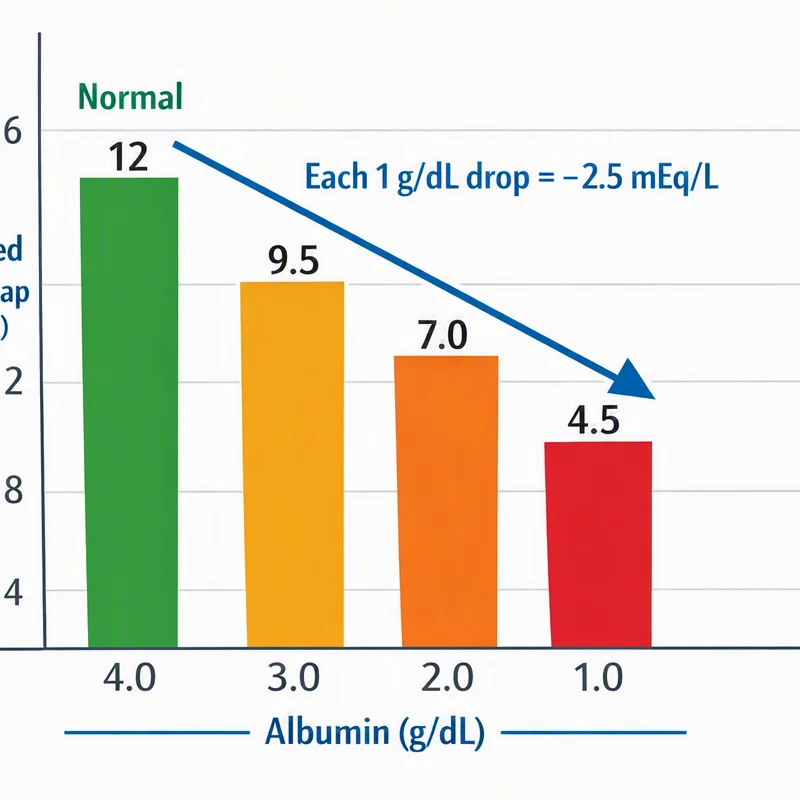
One of the most important modifications is the corrected anion gap, also called the albumin-corrected gap. Because albumin is a major unmeasured anion, low albumin can make the gap appear spuriously low or “normal.” In sepsis, hypoalbuminemia is frequent, so the uncorrected value may underestimate the true burden of acids.
A practical approach is to:
- Examine the sodium, chloride, and bicarbonate values from the chemistry panel.
- Determine the anion gap using a consistent formula.
- Check albumin and use an albumin-corrected gap if it is low.
- Cross-check the result with the blood gas and serum lactate.
Correction does not substitute for clinical judgment. It simply improves accuracy when assessing whether the patient has hidden acid accumulation. In septic patients, this step can prevent a missed diagnosis of ongoing acid generation.
High anion gap vs expected-range anion gap in sepsis
During sepsis, a elevated anion gap metabolic acidosis often indicates build-up of organic acids, especially lactate. This is the usual pattern when tissue oxygen delivery is impaired. Still, sepsis can also present with normal anion gap metabolic acidosis, particularly when bicarbonate is lost or when chloride rises relative to bicarbonate after large-volume fluid resuscitation.
That separation is important because a normal gap does not rule out significant illness. A patient may still have acidemia, elevated lactate, or impaired perfusion even if the calculated gap stays within the expected range. Mixed disorders are common in critical illness, so a “normal” result may mask concurrent problems.
Lactate is often the leading driver of a high gap in sepsis, but it is not the only one. If the patient has kidney injury, acids can accumulate because renal clearance is reduced. This can further increase the gap or complicate the pattern seen on the blood gas.
It helps to think the anion gap as a clue to the type of acidosis:
- High anion gap metabolic acidosis suggests unmeasured acids such as lactate or ketones.
- Normal anion gap metabolic acidosis indicates bicarbonate loss, chloride gain, or mixed physiology.
With sepsis, both patterns may occur over time as the patient’s perfusion, kidney function, and treatment response evolve.
Typical causes for high anion gap in septic patients with sepsis
The leading cause of an high gap in sepsis is lactate from lactic acidosis. This can be caused by tissue hypoperfusion, microcirculatory dysfunction, or impaired oxygen utilization. But an elevated anion gap should not be assumed to be lactate alone.
Other important causes include:
- Ketone-related acidosis, especially if the patient has diabetes, poor intake, or severe stress physiology.
- Kidney failure, which reduces acid excretion and allows unmeasured anions to accumulate.
- Poisonous alcohols, such as methanol or ethylene glycol, which are less common but high-risk and should be considered when the story does not fit sepsis alone.
These alternatives matter because sepsis can coexist with other metabolic problems. A patient may have infection plus ketoacidosis, or sepsis plus renal failure. The gap should therefore prompt a broader differential rather than a single-track conclusion.
If the anion gap is rising and lactate is not very high, clinicians should consider whether another process is contributing. This is one reason serial assessment is more useful than a single isolated number.
How to interpret the findings: what the result reveals and misses
The anion gap is best used as a clinical pointer, not a diagnosis. It can point to the presence of an acid-base disorder, but it does not determine the exact cause by itself. In sepsis, this is especially important because more than one process may be happening simultaneously.
A high gap may suggest accumulating unmeasured acids, but the number alone cannot tell you whether the cause is lactate, ketoacidosis, renal failure, or a toxin. Likewise, a normal gap does not exclude clinically important illness. That is why the anion gap must be paired with a blood-gas result, lactate level, kidney function, and the overall exam.
One useful way to interpret the number is to ask three questions:
- Is there low pH on the blood gas?
- Is the calculated gap elevated after considering albumin?
- Does the pattern fit the patient’s clinical context and perfusion status?
If the answer is yes to all three, the concern for clinically significant acid accumulation is higher. If there is a mismatch, evaluate mixed acid-base disease, laboratory timing issues, or a non-lactate cause of metabolic derangement.
In short, the number does not replace bedside assessment. It strengthens or undermines a hypothesis about what is happening physiologically.
When to repeat labs and assess severity
Among septic patients, repeat testing is often more informative than a single value. Serial lactate levels help reveal whether the patient is removing lactate or still producing it. Likewise, rechecking electrolytes can reveal whether the anion gap is getting better, unchanged, or worsening.
Clinicians also look at base deficit on the blood gas as an additional marker of metabolic burden. A worsening base deficit may suggest ongoing acidosis even if the gap has not yet changed dramatically. Together, these values can help with assessing severity and treatment response.
Follow-up labs are particularly helpful when:
- The first lactate is elevated and you want to monitor lactate clearance.
- There is concern for persistent tissue perfusion problems.
- Organ function is worsening or suspected renal failure.
- The initial anion gap and blood gas fail to match the clinical picture.
Following the trend can uncover improving perfusion after resuscitation or an occult decline that requires escalation. In critical illness, the pattern often is more important than the single value.
Frequently asked questions on anion gap during sepsis
What does anion gap indicate during sepsis?
During sepsis, the anion gap helps identify whether there is metabolic acidosis with unmeasured acids circulating in the blood. A high gap can suggest lactic acidosis due to tissue hypoperfusion, but it may also reflect ketoacidosis, renal failure, or toxic alcohol exposure. anion gap in chronic kidney disease It is an important hint, not an independent diagnosis.
Can sepsis cause a normal anion gap?
Absolutely. Sepsis can cause a normal anion gap metabolic acidosis, especially when bicarbonate is lost or chloride rises during fluid treatment. A normal result does not rule out serious illness, elevated lactate, or poor perfusion. Mixed acid-base disorders are common in sepsis.
Why should you correct the anion gap for albumin?
Albumin is a major unmeasured anion, so low albumin can make the measured anion gap look deceptively normal. Correcting for albumin gives a better estimate of the true acid burden. This is especially important in critical illness, where hypoalbuminemia is common.
Does a high anion gap always mean lactic acidosis in sepsis?
Not necessarily. Lactic acidosis is common, but a high anion gap can also come from ketoacidosis, renal failure, or toxic alcohols. The anion gap should always be interpreted with the blood gas, serum lactate, albumin, and the rest of the clinical context.
When is it best for an anion gap be repeated for a septic patient?
Repeat it when you are monitoring response to treatment, especially if lactate is elevated, perfusion is uncertain, or the patient’s condition is changing. Trending the anion gap with serial lactate, electrolytes, and base deficit helps show whether the metabolic derangement is improving or worsening.